ADU Investing in Los Angeles: California's Garage-Conversion Gold Rush
Real Estate Investing, ADU, Los Angeles, California, hard money, DSCR, real estate investor loans
ADU Investing in Los Angeles: California's Garage-Conversion Gold Rush
California’s ADU laws have turned ordinary Los Angeles backyards and garages into powerful income engines. For real estate investors who move quickly and finance smart with hard money and DSCR real estate investor loans, ADU projects can turn a single-family lot into a mini multifamily—without leaving city limits.
📌 Key Takeaway: Pairing California ADU opportunities with the right hard money and DSCR real estate investor loans is what turns a simple Los Angeles garage conversion into a scalable investment strategy.
Why ADUs Are the New Los Angeles Investment Play
In Los Angeles, accessory dwelling units (ADUs) are no longer a fringe idea. State-level reforms made it easier to add rental units on single-family lots, and the city has responded with tens of thousands of permits across California’s largest metro. For a real estate investor, that means you can buy a home with an existing garage, convert it, and suddenly own a property that performs more like a duplex—often with better yield than a straight single-family rental.
The key is understanding the numbers: ADU costs, permitting timelines, rent potential, and which Los Angeles neighborhoods actually pencil out. Layer in the right financing—like hard money and DSCR real estate investor loans—and you have a repeatable strategy instead of a one-off project.
“In today’s California market, the investors winning the ADU game are the ones who treat garage conversions like a small development deal—complete with clear budgets, timelines, and a hard money-to-DSCR financing plan.”
ADU and Garage
Conversion Costs in Los Angeles (2026 Reality Check)
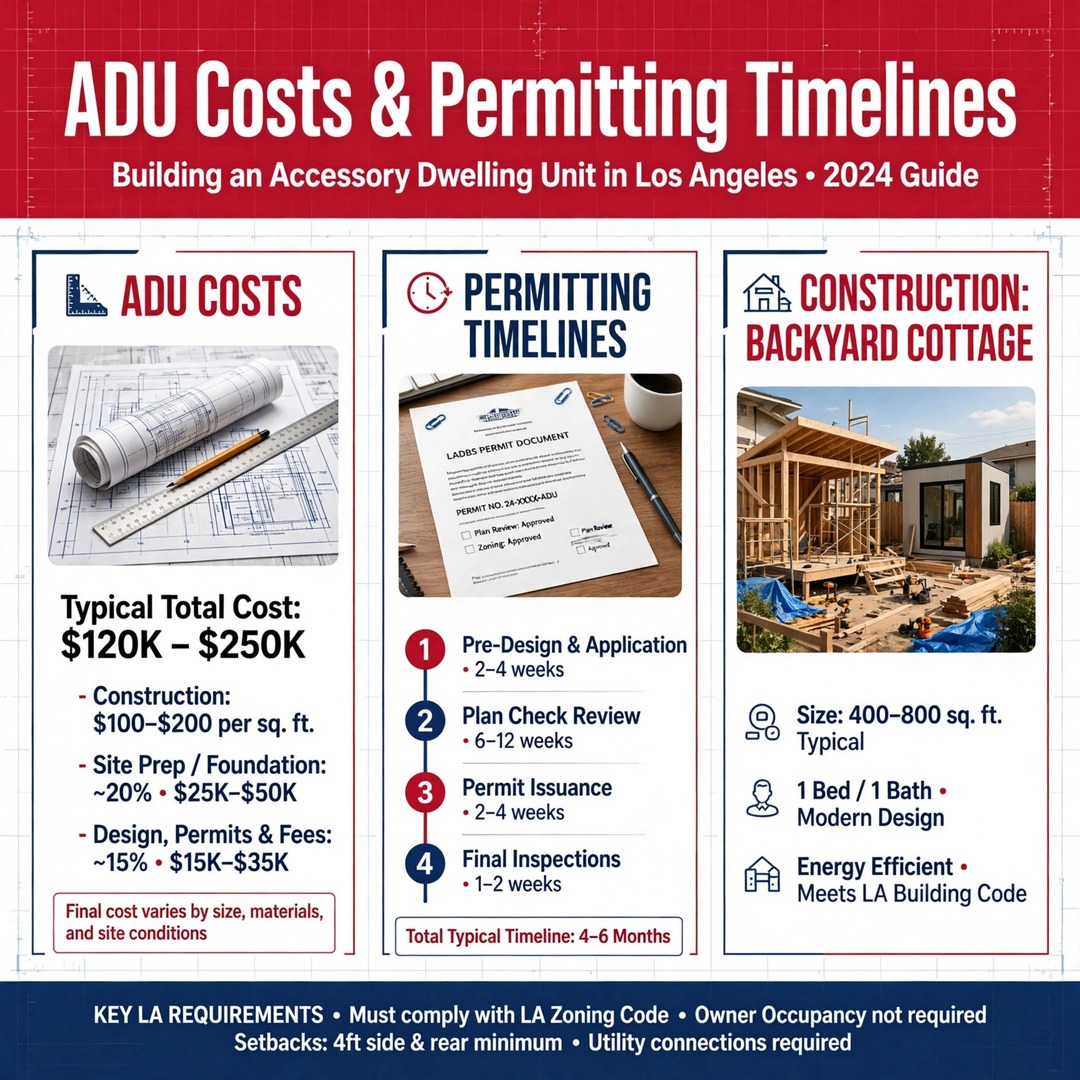
Construction pricing has climbed, but the spread between what you spend and what you can collect in rent still makes sense in many parts of California. Recent 2026 data across multiple builders and city permit records show:
Garage conversions (roughly 400–500 sq ft): typically $80,000–$200,000, with many projects clustering around $100,000–$180,000 depending on condition and finishes.
Detached or attached new-build ADUs: often $200,000–$450,000 all-in for 600–1,200+ sq ft, or about $250–$550+ per square foot including soft costs.
Soft costs (design, permits, utilities): another $15,000–$35,000 on average for Los Angeles, according to multiple 2026 cost guides.
Garage conversions are the classic “gold rush” play: lower cost of entry, faster build time, and strong rent for the square footage. Detached ADUs cost more but can command higher rents and boost appraised value significantly—important when you plan to refinance into a DSCR loan once the project is stabilized and ready for long-term real estate investor financing.
💡 Pro Tip: When you underwrite ADU deals in Los Angeles, run two scenarios—one using your short-term hard money rates and one using your projected DSCR refinance. If the numbers still work after you roll into a long-term real estate investor loan, you’re on the right track.
Permitting Timelines: How Long Until Your ADU Cash-Flows?
California law says cities should approve or deny a complete ADU application within 60 days, but real-world Los Angeles data tells a different story. Analysis of tens of thousands of permits shows:
Application to permit issuance: recent medians fall around 4–5 months (roughly 119–143 days), with some outliers as fast as 2–3 weeks and others stretching past a year when plans bounce between departments.
Permit to final sign-off: typically 11–15 months from permit issuance to certificate of occupancy, depending on whether you’re doing a garage conversion, attached unit, or full detached ADU.
In practice, most investors should underwrite 16–20 months from application to a rent-ready unit. That long runway is exactly why access to flexible hard money matters—your capital has to survive plan checks, resubmittals, and construction delays before your DSCR take-out loan ever enters the picture.
Successful ADU investors underwrite realistic timelines and line up hard money and DSCR financing that can wait for rent-up.
📌 Key Takeaway: In Los Angeles and across California, your ADU timeline is a financing problem as much as a construction problem. Choose real estate investor loans that match the real-world permit and build cycle.
Rent Potential: What Can an LA ADU Actually Earn?
Rents vary by submarket, unit size, and finishes, but 2026 numbers show why ADUs are so attractive. In high-demand pockets like Studio City and Sherman Oaks, one-bedroom ADUs can often command $1,900–$2,400 per month. Westside and near-tech hubs such as Culver City and Mar Vista can see similar or higher rents for well-designed units with parking and outdoor space.
In more cost-efficient neighborhoods—parts of the San Fernando Valley, South LA, and Harbor-adjacent areas—rents may be lower, but so are land and construction costs. A garage conversion that costs $130,000 and rents for $1,700 a month can still hit an attractive yield, especially if you structure the debt with a DSCR loan focused on property cash flow instead of your personal income.
💡 Pro Tip: Many California lenders will size DSCR real estate investor loans based on a minimum DSCR ratio (for example, 1.1–1.25x). When you underwrite Los Angeles ADUs, stress-test your rents and expenses to be sure your finished unit qualifies for the DSCR terms you want.
Best Los Angeles Neighborhoods for an ADU Conversion Play
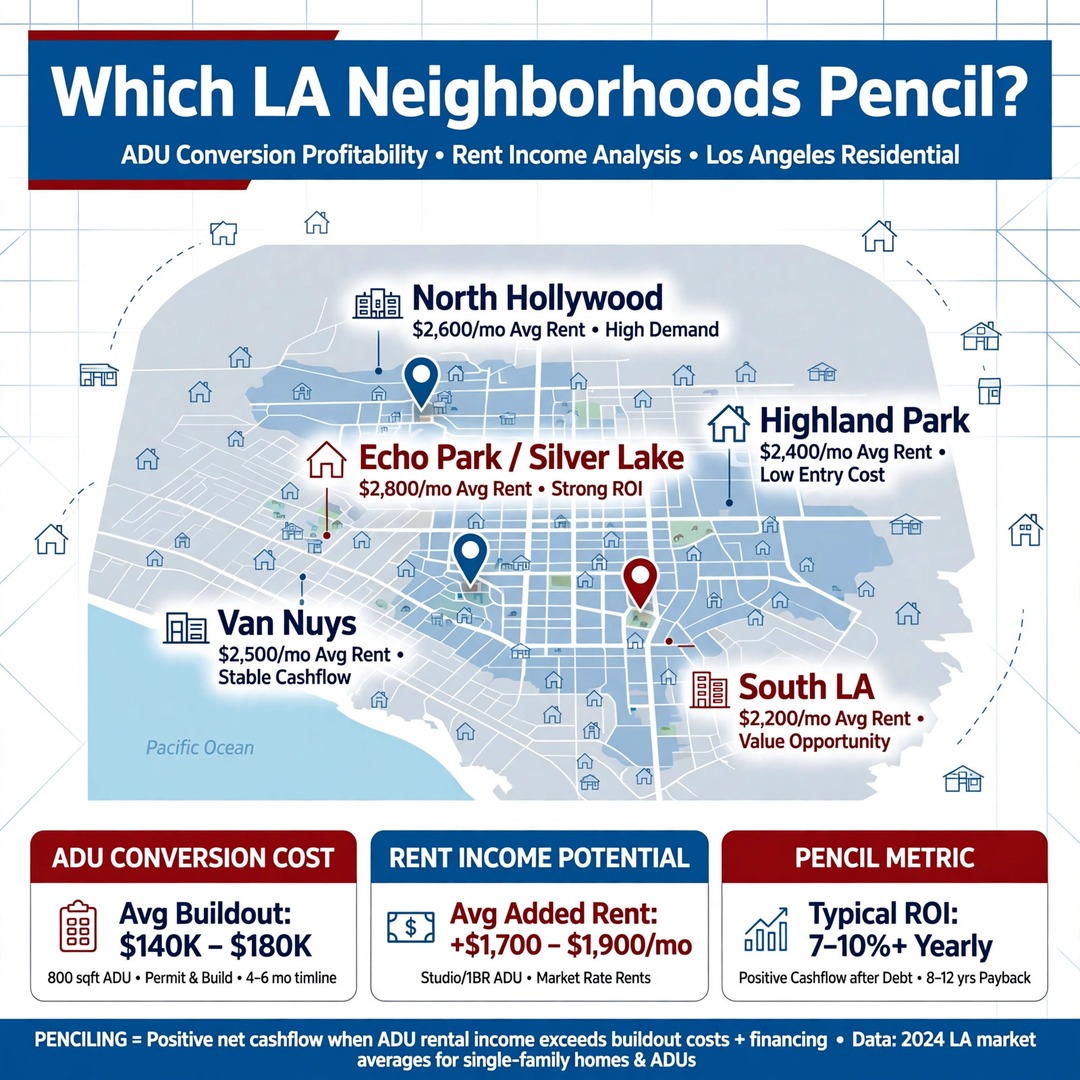
Permit data makes one thing clear: the San Fernando Valley is ground zero for ADU activity. Neighborhoods like North Hollywood, Reseda, Van Nuys, Granada Hills, Northridge, Pacoima, Sun Valley, Sylmar, and Winnetka consistently rank at the top for ADU permits. These areas offer:
Flat, R1-zoned lots with existing detached garages—perfect for conversion.
Relatively lower land costs than the Westside, improving overall project yield.
Strong tenant demand from workers in nearby employment centers.
For top-tier ROI and appreciation, investors are also targeting Studio City, Sherman Oaks, Culver City, and Mar Vista. These submarkets combine high rents with long-term value growth, though land acquisition is more expensive and sites can be trickier. Budget-conscious investors often look to South LA, Harbor-area neighborhoods, Westchester/South Bay–adjacent zones, and more affordable Valley pockets for lower build costs and practical garage conversions.
📌 Key Takeaway: Whether you’re in a prime Los Angeles zip code or a more affordable California submarket, the right mix of hard money for the build and DSCR real estate investor loans for the hold can make an ADU conversion viable.
Financing the Play: How Freedom Lending’s Hard Money and DSCR Loans Fit In
ADU investing lives or dies on capital structure. You’re tying up money for 16–20 months before full stabilization, and banks don’t always move at the speed of a competitive Los Angeles offer. That’s where Freedom Lending’s hard money and DSCR real estate investor loans come in for California investors who need speed and flexibility.
Hard money for acquisition + construction: Freedom Lending can fund the purchase of the property and the ADU build, with construction draws that match your build schedule. That means you can close fast on a deal, then tap into renovation funds as milestones are hit—demo, framing, rough-in, finishes, and final.
DSCR loans for long-term holds: Once the ADU is complete and rented, a DSCR loan lets you refinance into a more permanent structure based primarily on the property’s income, not your W‑2. For many California investors building small portfolios, this is how you recycle capital into the next project.
And remember, buying where you live isn’t the only play. Plenty of California investors use hard money to move fast on an out-of-area deal, complete the ADU build, then refinance and hold the finished property as a rental. Freedom Lending funds investors nationwide, so you can apply the same ADU strategy in other landlord-friendly markets as well using tailored real estate investor loans.
💡 Pro Tip: Before you write an offer on a Los Angeles ADU opportunity, talk with your lender about both phases of the deal—hard money for the heavy lifting, and a DSCR refinance to lock in long-term cash flow.
Turn Your Garage Into a Gold Mine
Los Angeles ADUs aren’t a fad—they’re a structural shift in how California adds housing and how investors create yield on single-family lots. If you understand the true ADU costs, realistic permitting timelines, and rent potential by neighborhood, you can structure deals that work on paper and in practice. The final piece is financing that lets you move quickly, survive the build, and exit into stable, cash-flowing debt using the right mix of hard money and DSCR real estate investor loans.
If you’re ready to explore an ADU or garage-conversion strategy—whether on your own property or a new acquisition—reach out for tailored hard money and DSCR options. Contact Rob at [email protected] or call 903-806-4400 to talk through your next ADU investment.