Short-Term Rentals Near Arlington's Entertainment District: The Numbers
Real Estate Investing, Short-Term Rentals, Arlington Texas
Short-Term Rentals Near Arlington's Entertainment District: The Numbers
With AT&T Stadium, Globe Life Field, and Six Flags pulling in millions of visitors a year, Arlington’s Entertainment District has become one of Texas’s most compelling short-term rental (STR) markets. For investors, the key question is simple: do the numbers really beat traditional long-term rents—and how do you finance these deals efficiently?
Why Arlington STRs Can Outperform Long-Term Rents
Arlington sits in a rare sweet spot: year-round events, national sports franchises, a major theme park, and strong drive-to demand from Dallas–Fort Worth and beyond. Instead of collecting one rent check per month, STR owners can tap dozens of bookings a year tied to:
Dallas Cowboys and college football games at AT&T Stadium
Texas Rangers home stands and playoff runs at Globe Life Field
Six Flags Over Texas and Hurricane Harbor’s peak summer seasons
Layer in concerts, conventions, and the 2026 World Cup activity, and you have a demand driver that simply doesn’t exist in most suburban long-term rental markets.
📌 Key Takeaway: Arlington’s Entertainment District benefits from multiple demand pillars—sports, theme parks, and events—reducing your reliance on any single season.
Occupancy Math: Turning Visitor Demand into Revenue
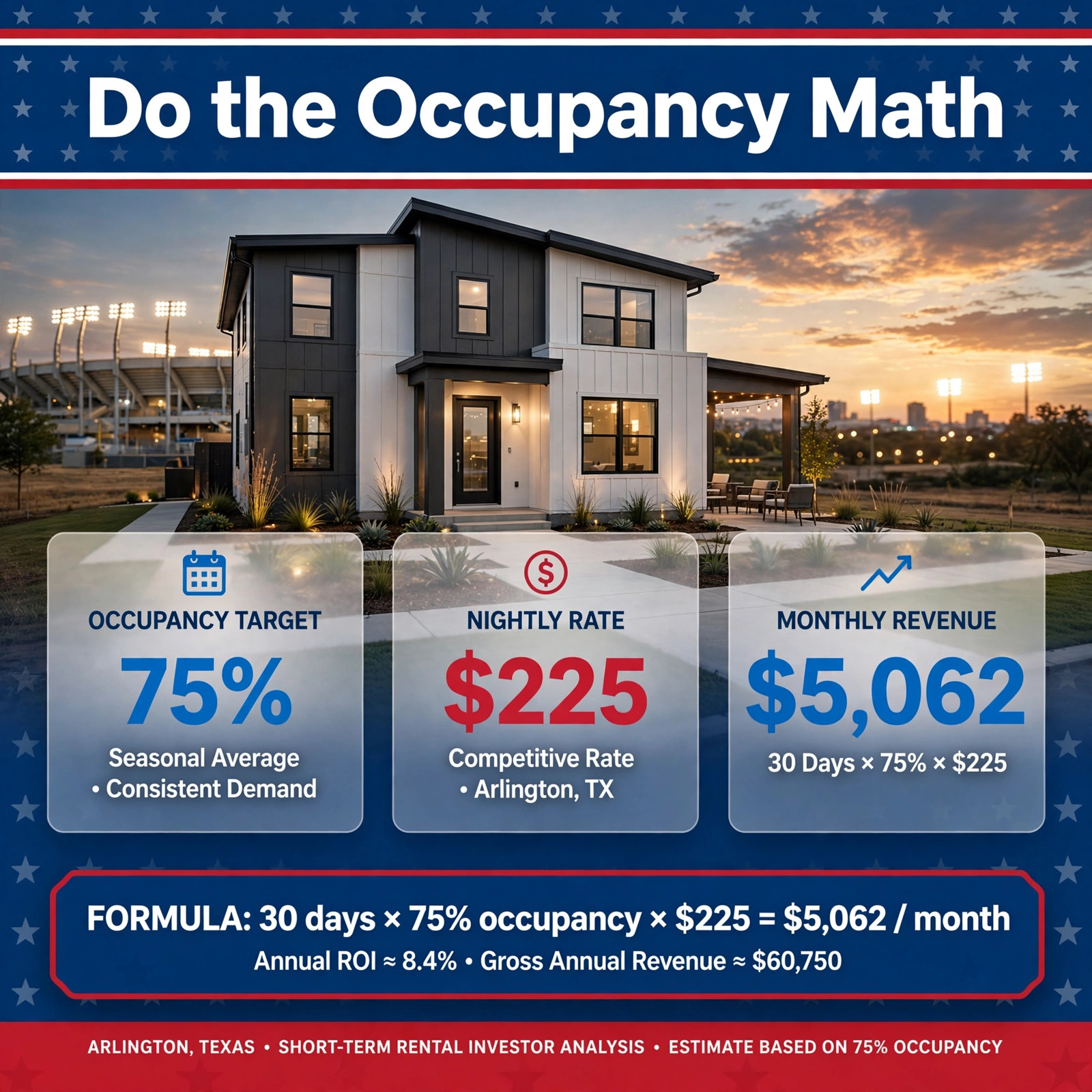
Multiple data providers track Arlington’s STR performance, and while their numbers vary, the story is consistent: occupancy is healthy and trending upward. AirDNA shows an average occupancy around 54% with an average daily rate (ADR) of about $189, while other sources like StaySTRA report April occupancy near 58.7% and a forecast from CoStar points toward roughly 62.6% by the end of 2026 ( AirDNA; StaySTRA; CoStar).
To see how that stacks up against a typical long-term rental, consider a conservative scenario near the Entertainment District:
Occupancy: 55% (about 17 nights per month on average)
ADR: $185 (blending high-demand event nights with slower weekdays)
Monthly gross revenue ≈ 17 nights × $185 = $3,145. Many comparable long-term rentals in the area might achieve $2,000–$2,300 per month. Even after higher expenses (cleaning, utilities, management, and taxes), a well-run STR can still outperform on cash flow and total return, especially during peak months where occupancy often climbs above 60% and ADR spikes for major games and concerts.
“The spread between STR income and long-term rent is what gives you room for higher expenses, professional management, and still hitting your target returns.”
💡 Pro Tip: Underwrite your deals on conservative averages, then treat event nights and seasonal spikes as upside, not the baseline.
Local Rules: Where You Can (and Can’t) Operate in Arlington
Arlington is strict but clear about short-term rentals. Any stay under 30 days is considered an STR, and you must have an annual city permit to operate ( City of Arlington).
For investors targeting the Entertainment District, zoning is critical. STRs are allowed in:
The designated STR Zone surrounding the Entertainment District (roughly a one-mile area around the stadiums)
RM-12 and RMF-22 residential districts, plus certain non-residential and mixed-use districts
Planned Developments with densities of 12+ units per acre
Most traditional single-family neighborhoods outside these zones are off-limits. On top of that, investors must budget for:
$500 non-refundable permit fee each year
$1M liability insurance per occurrence
Combined 15% hotel occupancy tax (6% state + 9% city), with city HOT returns filed separately
Operating without a permit is a misdemeanor, and repeat violations can lead to permit revocation and fines ( BNBCalc). In other words, compliance is part of your investment math.
Properties inside Arlington’s STR zones can command premium nightly rates and strong occupancy.
⚠️ Warning: Always confirm current zoning maps and STR regulations with the City of Arlington before you close—rules can evolve, and assumptions can be expensive.
Which Property Types Perform Best Near the Entertainment District?
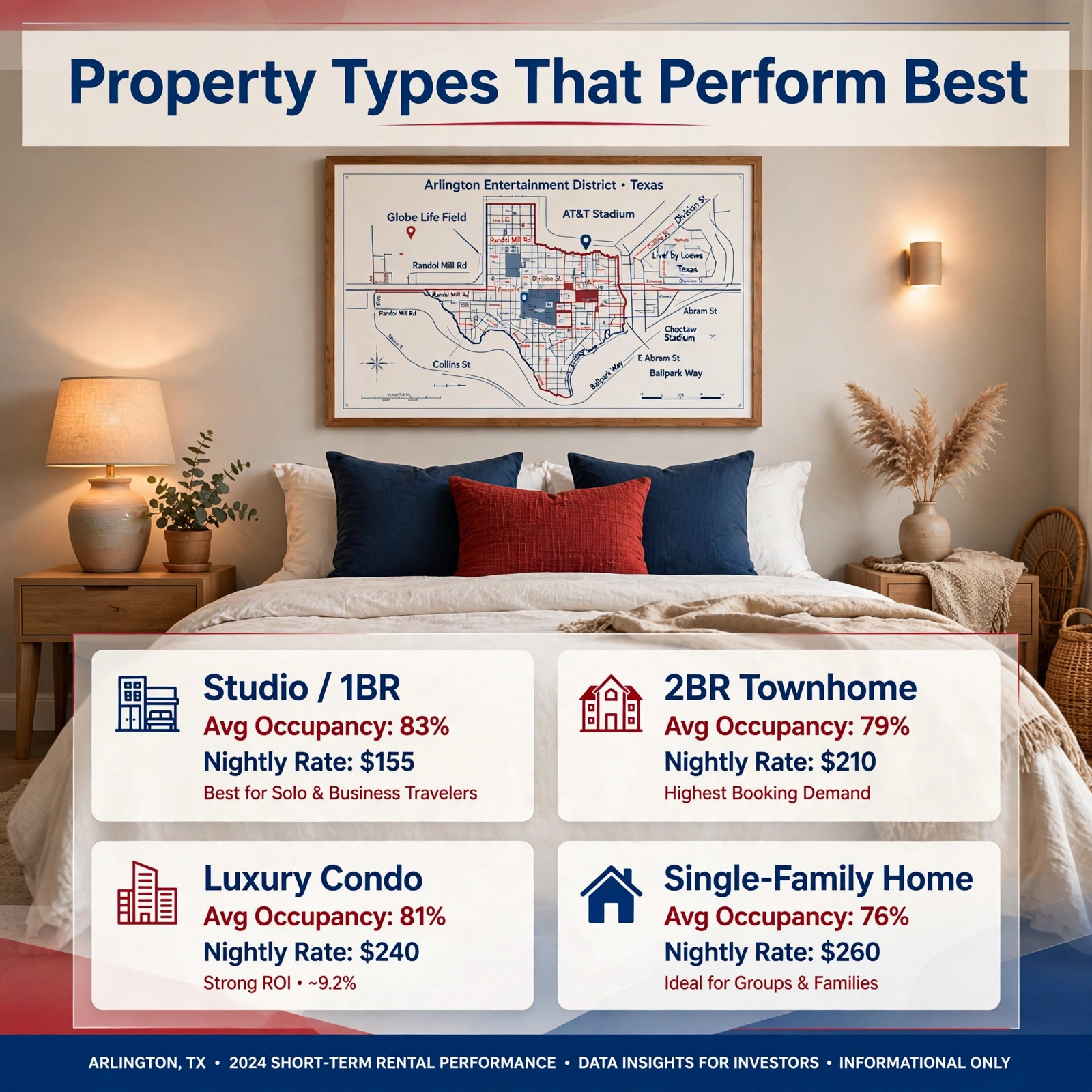
Not every property near the stadiums performs the same. Based on how visitors actually travel to Arlington, certain layouts and locations tend to stand out:
3–4 bedroom single-family homes within a short drive or walk of AT&T Stadium and Globe Life Field. These attract families, friend groups, and corporate guests looking to split costs, often achieving higher ADRs and strong weekend occupancy.
Townhomes and small multifamily units in RM-12 or RMF-22 zones. Multiple doors on one lot can diversify bookings and simplify operations, especially if you standardize furnishings and cleaning.
Walkable or “stadium-view” properties. Even a modest home can outperform if guests can walk to games and concerts, avoiding parking and rideshare hassles.
Smaller one-bedroom units can still work, especially for business travelers and couples, but the real revenue leaders in this submarket are well-designed spaces that comfortably sleep 6–10 guests while staying under Arlington’s maximum occupancy of 12 people.
📌 Key Takeaway: In Arlington, the best STRs combine the right zoning, the right bedroom count, and easy access to the stadiums and parks.
Financing the Strategy: How Freedom Lending’s Hard Money and DSCR Loans Help
Finding the right property is only half the equation. To capitalize on Arlington’s STR potential—especially in competitive zones—you need financing that understands investor deals, not just owner-occupied homes.
Hard Money for Acquisitions and Rehab
Freedom Lending’s hard money loans can help you move quickly on properties inside the STR Zone or key multifamily districts. Investors often use hard money to:
Close fast on off-market or distressed properties before competing buyers
Fund renovations aimed at STR guests—extra bathrooms, durable finishes, smart locks, and stylish furnishings
Stabilize the property with strong reviews and consistent bookings before refinancing into long-term debt
DSCR Loans That Count Short-Term Rental Income
The real game-changer for Arlington STR investors is how Freedom Lending’s DSCR loans are structured. Instead of relying on your W-2s or tax returns, these loans focus on the property’s ability to cover its own debt—its Debt Service Coverage Ratio ( Investopedia).
Crucially for this strategy, Freedom Lending’s DSCR loans can qualify short-term rental income. That means:
You can use projected or actual STR income (supported by market data and platforms like AirDNA) to qualify, rather than traditional employment income.
Investors with multiple properties or complex tax returns can still grow their portfolio without being limited by conventional underwriting.
The stronger your occupancy and ADR, the easier it is to meet or exceed the DSCR threshold lenders look for.
💡 Investor Advantage: Pair hard money for acquisition and rehab with a DSCR take-out loan that recognizes your STR income, and you have a clear path from purchase to long-term, scalable financing.
Putting It All Together—and Your Next Step
Arlington’s Entertainment District offers a rare combination of strong visitor demand, improving occupancy trends, and clearly defined STR rules. When you understand the occupancy math, stay inside the city’s zoning and permitting lines, and target the right property types, short-term rentals here can significantly outperform traditional long-term rents.
Freedom Lending’s hard money and DSCR loan options are built for this exact strategy—helping investors acquire, improve, and hold high-performing Arlington STRs without relying on conventional income documentation. If you’re ready to run the numbers on a specific property or want to talk through your game plan around AT&T Stadium, Globe Life Field, or Six Flags, it’s time to connect.
To discuss your Arlington short-term rental strategy and financing options, contact Rob at [email protected] or call 903-806-4400.