The Knowledge That Funds Your Next Deal
Practical guides, market insights, and lending strategies written for real estate investors who move fast and need financing that keeps up.
Home > Blog
Latest Articles
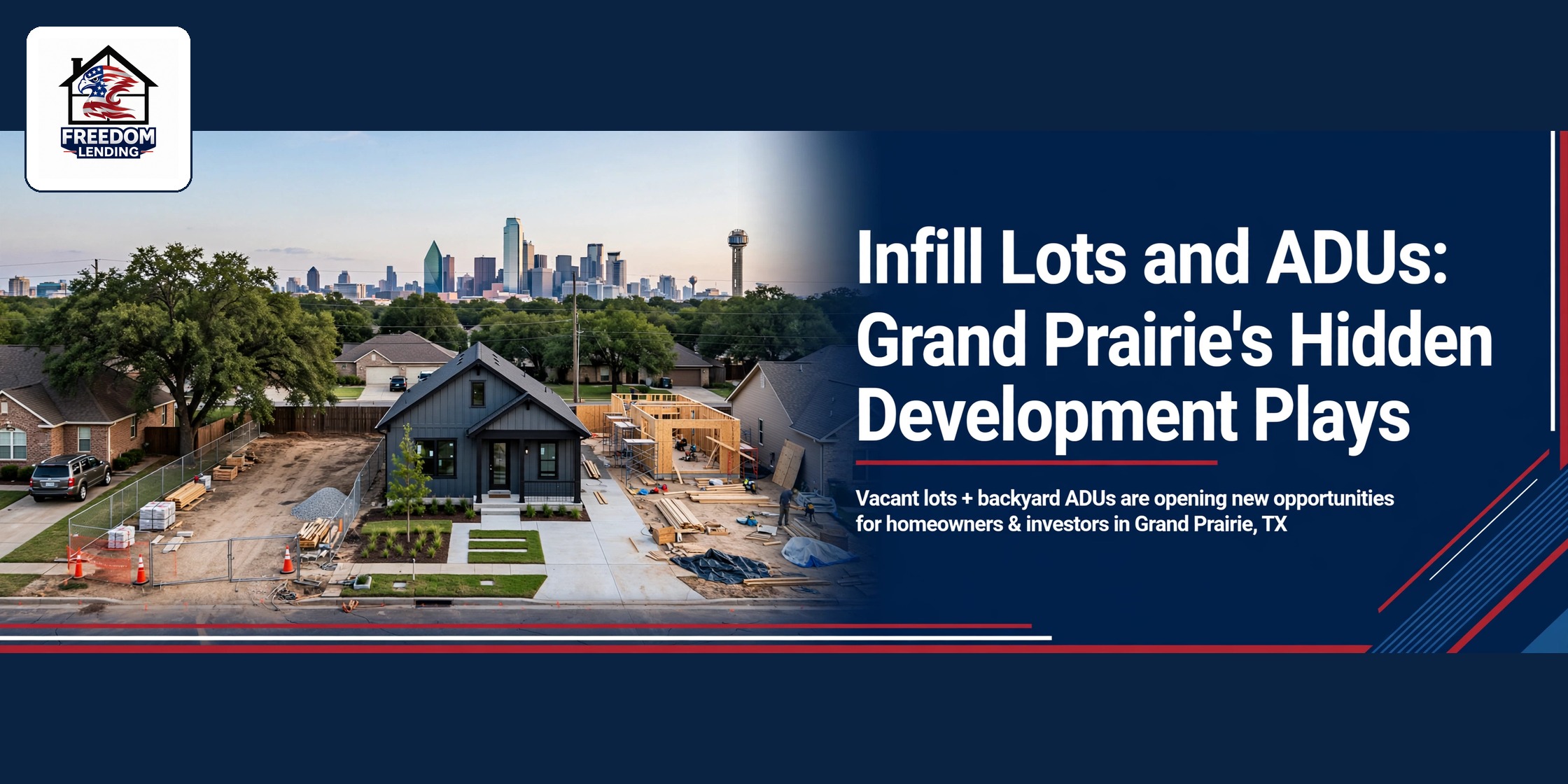
Infill Lots and ADUs: Grand Prairie's Hidden Development Plays
Real Estate Investing, Grand Prairie Infill, ADUs, Hard Money, DSCR Loans, Texas Real Estate Investor Loans
Infill Lots and ADUs: Grand Prairie’s Hidden Development Plays
Between Dallas and Fort Worth, Grand Prairie, Texas sits in a sweet spot for small, creative development. For the nimble real estate investor, overlooked infill lots and carefully planned accessory apartments can turn into high-yield projects—especially when paired with flexible hard money and DSCR financing tailored for builders and buy‑and‑hold investors.
Why Grand Prairie’s Infill Lots Deserve a Closer Look
Grand Prairie’s market in late 2026 is balanced and slightly buyer‑friendly. Median sale prices hover around the mid‑$300,000s, with homes generally selling in about 30–40 days and sale‑to‑list ratios in the high‑90% range, according to sources like Redfin and Realtor.com. That stability matters for a small developer: you’re not betting on wild appreciation, you’re building value through smart design and efficient execution on the right infill lots.
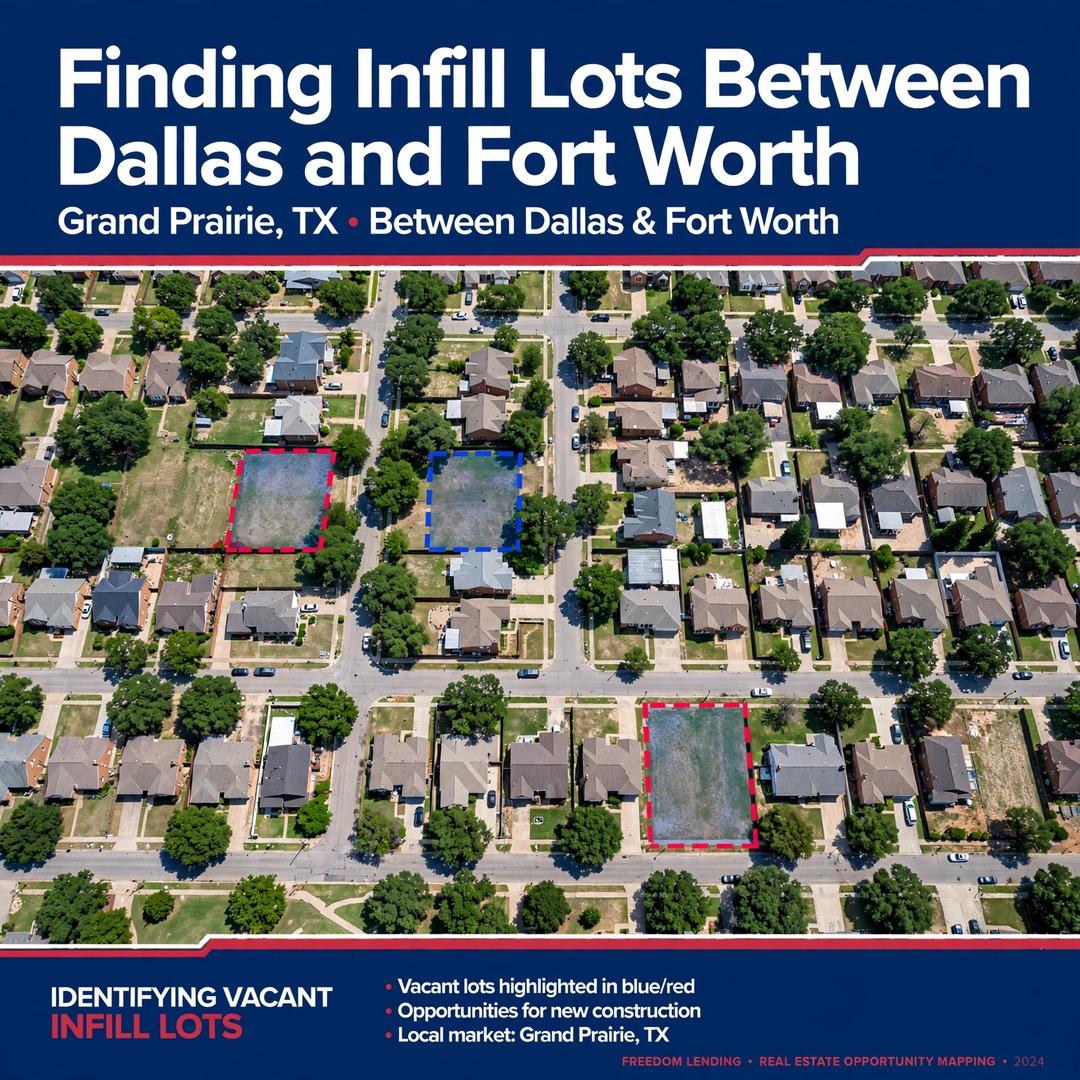
At the same time, the city still has a surprising number of infill opportunities in Grand Prairie. Recent counts show dozens of vacant residential lots—many of them sitting for months—plus city‑owned sites and planned developments that can fit new housing. A shovel‑ready lot like the PD‑315 parcel on N. M.L. King Jr. Blvd, for example, has been marketed under $100,000, while other residential lots range from roughly $165,000 to $280,000. For a Texas realestateinvestorloans client, those numbers can pencil when paired with the right build and exit strategy backed by hard money and DSCR loans.
📌 Key Takeaway: In a steady Grand Prairie market, your edge isn’t speculation—it’s finding overlooked infill lots and using the right financing structure to unlock their value.
How to Find Profitable Infill Lots in Grand Prairie
Step one is learning where to look. Infill deals rarely jump off the page; they hide between standard listings and zoning maps. Here are practical ways to source them in Grand Prairie, Texas:
MLS filters: Search for “vacant land” or “lots” under one acre inside existing neighborhoods, not on the fringe. Long days‑on‑market can signal motivated sellers and room for negotiation, especially in a buyer‑leaning environment where your Grand Prairie infill offer stands out with fast hard money terms.
City economic development listings: Grand Prairie’s website highlights city‑controlled parcels near major corridors like SH‑360 and Lake Ridge Parkway. Some are larger tracts that can be subdivided into multiple small lots for a phased strategy backed by hard money construction loans.
Drive‑by scouting: Walk or drive established neighborhoods near transit and employment hubs. Look for fenced dirt, overgrown parcels, or “For Sale by Owner” signs that never make it to the big portals. Pair this with a quick call to your Texas infill lender to confirm what they’ll fund.
💡 Pro Tip: Before writing an offer, call Planning & Development to confirm zoning, setbacks, and whether duplex or accessory apartments are allowed on that specific lot or PD district. Then confirm with your hard money lender that the proposed use and exit align with their guidelines.
ADU Reality Check in Grand Prairie: What’s Actually Allowed
On paper, this post is about ADU development—but in Grand Prairie, the details matter. The city doesn’t use the term “ADU” in its code. Instead, it recognizes “Accessory Apartments”, and the rules are stricter than in many other Texas cities.
Detached backyard cottages or garage apartments are not allowed as separate dwellings in standard single‑family zones. The only realistic ADU‑style play is an attached or internal accessory apartment—and even that is only conditionally permitted in SF‑A and 2F districts, or in certain planned developments with custom rules. That means the smart Grand Prairie infill strategy is:
Targeting lots already zoned SF‑A or 2F, where duplex or accessory apartments are allowed, or
Working within a PD where a small second unit or stacked duplex is specifically written into the ordinance.
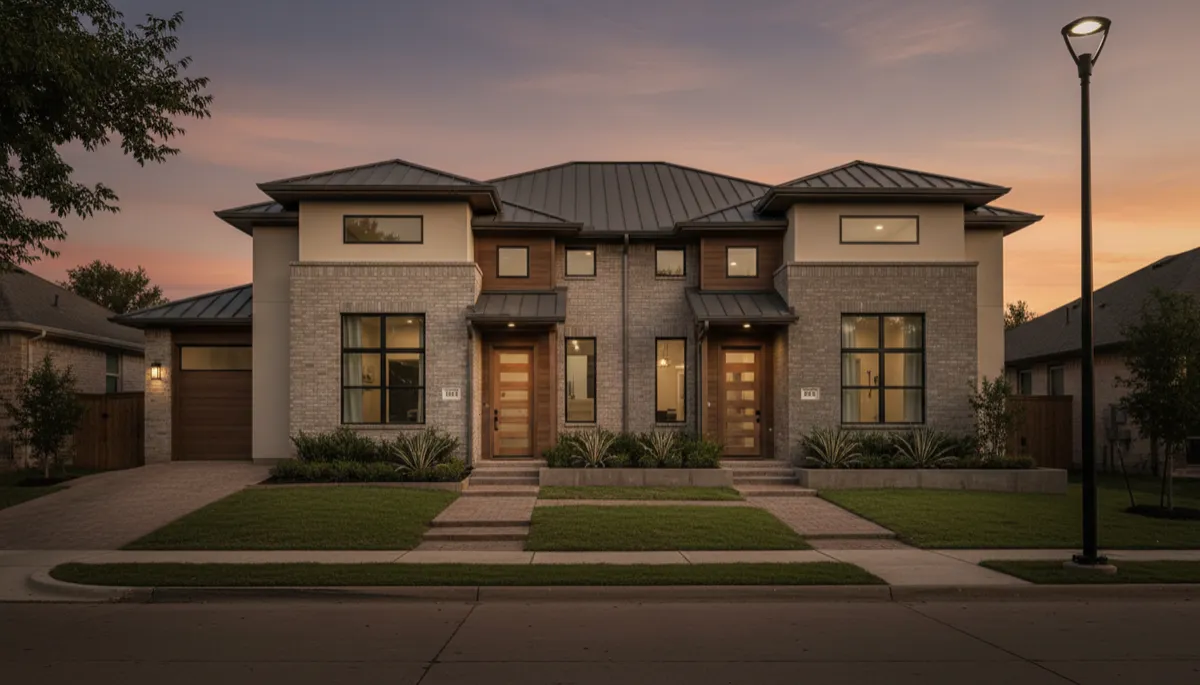
Duplex and accessory apartments on infill lots can stack rental income on one foundation.
“In Grand Prairie, the winning ADU play isn’t a tiny house in the backyard—it’s a well‑designed internal accessory apartment that underwrites with strong DSCR numbers.”
Running the ADU Cost Math: A Simple Framework
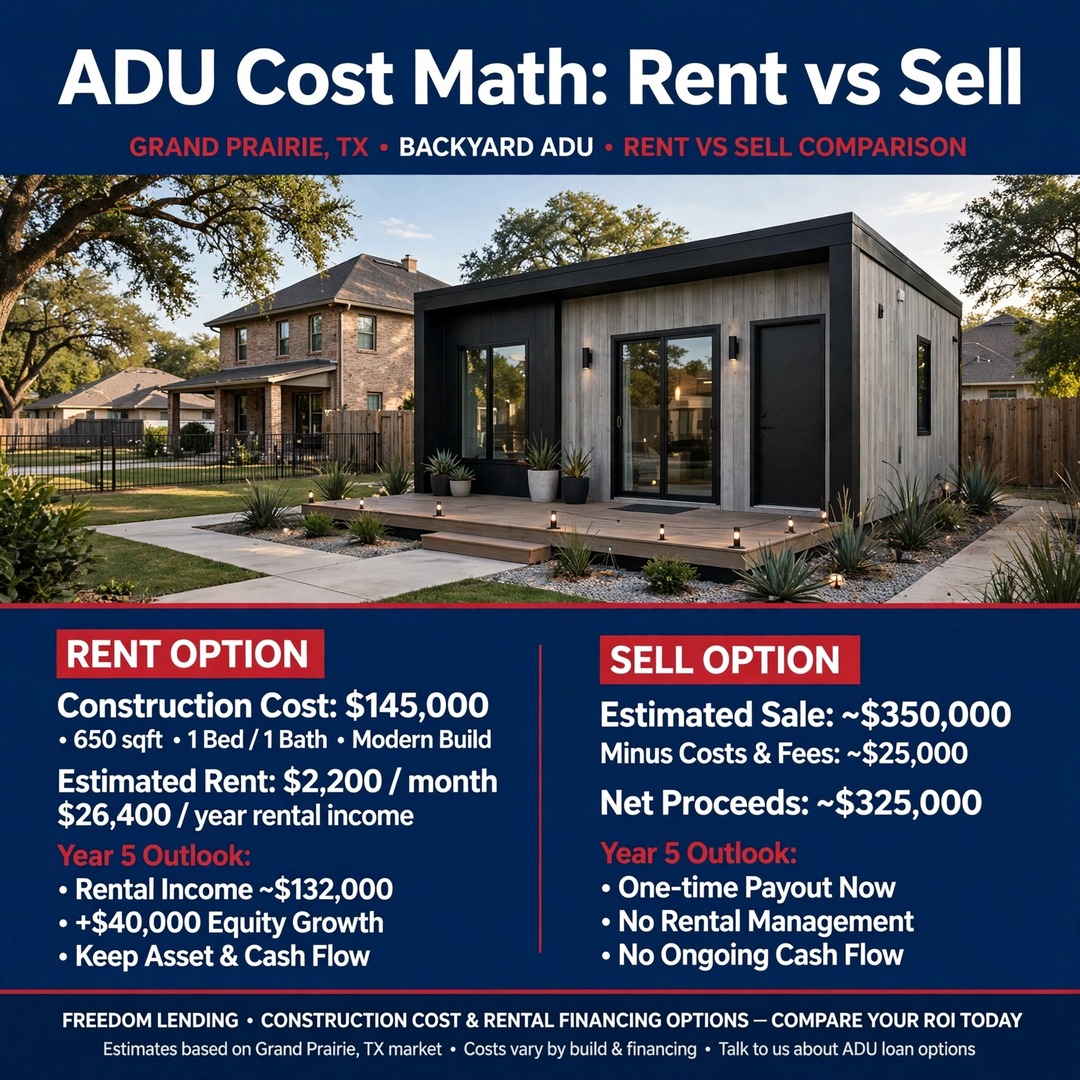
Once you’ve confirmed zoning, the next step is ADU cost math. For an internal accessory apartment—say, a one‑bedroom, 450–600 square foot unit carved from or added onto a new build—Grand Prairie construction costs often land in the $150–$200 per square foot range for efficient, rental‑grade finishes. Call it $90,000–$120,000 all‑in for the secondary unit in today’s environment, including design, permits, and utilities.
On the income side, an attached one‑bedroom near employment centers can often command $1,200–$1,500 per month, depending on finishes and location. Even at $1,300 per month, that’s $15,600 per year. If your all‑in ADU cost is $100,000, you’re looking at a 15–16% gross yield before expenses—a compelling add‑on to the main home’s economics, especially when financed with DSCR‑friendly terms that look at rental income rather than your W‑2.
💡 Pro Tip: Underwrite the ADU as a standalone investment. If the internal accessory apartment on your Grand Prairie infill lot works at today’s DSCR loan rates by itself, the main house becomes upside.
Rent vs. Sell: Choosing the Right Exit Strategy
With a new build plus accessory apartment, you typically have three exits:
Sell the finished property: In a market where median sales hover around $350K–$370K, a well‑designed duplex‑style home or unit with an internal accessory apartment can justify a premium. This strategy aims to capture built‑in equity and recycle your hard money capital quickly into the next Grand Prairie lot.
Keep and rent both units: Structure the property so the combined rents comfortably cover a DSCR loan—ideally with a DSCR above 1.2–1.25. In Texas, many investors prefer this route to build a small portfolio of Grand Prairie rentals that throw off monthly cash flow.
House‑hack hybrid: Live in one unit, rent the other, and later convert to a full rental once you move on. This can be a low‑risk way to learn small‑scale development while locking in long‑term DSCR financing.
📌 Key Takeaway: Run numbers for both exits—sell and rent—before you break ground. Let the stronger scenario guide your design choices, your hard money loan structure, and your eventual DSCR take‑out.
How Freedom Lending’s Hard Money and DSCR Loans Power This Strategy
Small development lives or dies on capital. Traditional banks often move slowly and shy away from quirky infill sites, complex zoning, or first‑time builders. That’s where Freedom Lending steps in for Texas investors with tailored hard money and DSCR solutions designed for infill and ADU‑style projects in markets like Grand Prairie.
Hard money for lot + construction: Freedom Lending can fund both the lot purchase and the vertical build, with draws that match your construction schedule. You close quickly on the dirt, then tap construction funds as you pour the slab, frame, rough‑in, and finish—keeping cash flow predictable and your crew moving on your Grand Prairie infill project.
DSCR take‑out loans: Once the project is stabilized with signed leases, a DSCR loan lets you refinance out of short‑term hard money into long‑term, rental‑focused financing. Underwriting emphasizes property income, not just personal income, which is ideal for scaling a Grand Prairie rental portfolio.
For a realestateinvestorloans client building a duplex or home with an accessory apartment, that one‑two punch—hard money for speed, DSCR for stability—can turn an overlooked Grand Prairie infill lot into a reliable asset in your Texas holdings.
Ready to Hunt Infill and ADU Opportunities in Grand Prairie?
Grand Prairie may not allow detached backyard ADUs, but the combination of infill lots, attached accessory apartments, and duplex‑style builds still offers a powerful path for the focused small developer. With careful lot selection, realistic ADU cost math, and a clear rent‑vs‑sell plan, you can create repeatable projects that work in today’s balanced market.
If you’re serious about turning Grand Prairie infill into your next play, you’ll want a lending partner who understands both the zoning quirks and the construction realities. Freedom Lending is built for that role, with hard money and DSCR options tailored to Texas investors.
To discuss your next infill or ADU‑style project in Grand Prairie, contact Rob at [email protected] or call 903-806-4400. Talk through your lot, your plan, and how the right hard money and DSCR structure can help you build faster—and smarter—in the heart of DFW.

Rob Trigg
Rob Trigg brings discipline, leadership, and proven operational experience into the lending world. Born on July 4, 1976, Rob is a highly decorated retired U.S. Army Staff Sergeant who dedicated 21 years of service to the United States Army, including five combat tours during Operation Enduring Freedom and Operation Iraqi Freedom. Throughout his military career, he built a reputation for integrity, accountability, precision, and an unwavering commitment to excellence — values that continue to define both his personal and professional life today.

At Freedom Lending, we believe lending should be built on integrity, honesty, and transparency. Every client relationship is guided by trust, clear communication, and a commitment to helping you move forward with confidence.
Whether you're funding your next investment or growing your real estate portfolio, Freedom Lending is your pathway to financial freedom.



Call us
+1 346-594-6988
Email Us
Copyright © 2026 Freedom Lending. All rights reserved.