
The Knowledge That Funds Your Next Deal
Practical guides, market insights, and lending strategies written for real estate investors who move fast and need financing that keeps up.
Home > Blog
Latest Articles

Military Rentals and STRs in San Diego: Two Paychecks, One Market
Real Estate Investing, Military Rentals, Short-Term Rentals
Military Rentals and STRs in San Diego: Two Paychecks, One Market
San Diego is one of the rare U.S. markets where two powerful demand engines run side by side: a massive, stable military population and year‑round tourism. For a real estate investor, that means one metro, two ways to get paid — BAH‑backed long‑term rentals near bases and short‑term rentals along the coast, all supported by the right mix of hard money and DSCR real estate investor loans.
Why San Diego Works for Dual‑Strategy Investors
San Diego’s housing market in 2026 is expensive but resilient. Countywide median home prices hover around $910,000, with detached homes closer to $1.07 million, and inventory sitting near three months — still a seller‑leaning environment, even as higher rates cool demand (sources: San Diego Association of Realtors, local market reports).
Underneath those numbers is a powerful stabilizer: the military. The region’s military activity generates roughly $61 billion in annual economic output and supports more than 350,000 jobs, while thousands of service members and families cycle through bases like Naval Base San Diego and Camp Pendleton every year. Many can’t get on‑base housing and instead rely on the private rental market, backed by predictable Basic Allowance for Housing (BAH) checks.
📌 Key Takeaway: For a San Diego real estate investor, that military stability acts like a floor under rents — especially when paired with smart real estate investor loans built for income‑producing properties.
Layer on top of that a tourism engine fueled by beaches, convention traffic, and year‑round sunshine, and you have a metro where long‑term and short‑term rentals both have strong, distinct lanes — if you structure your hard money and DSCR financing correctly.
BAH‑Backed Long‑Term Rentals Near the Bases
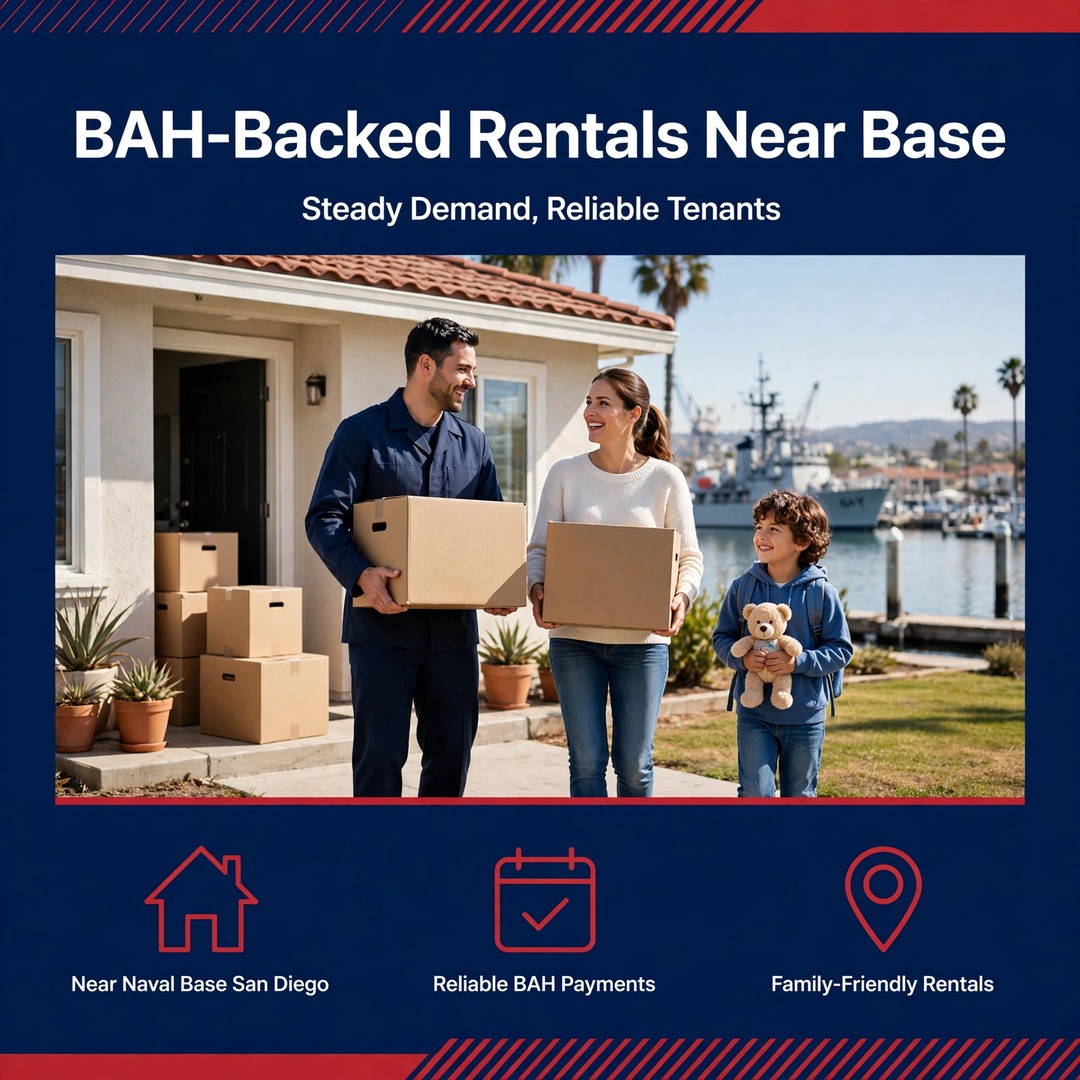
For many investors, the most underrated play in San Diego is the simple, boring, cash‑flowing rental targeted at military families. An enlisted member at E‑6 with dependents receives around $4,400 a month in BAH in San Diego, and that allowance is designed to cover local rents. When on‑base housing is full — and waitlists can stretch for months — those families turn to nearby neighborhoods like Chula Vista, Serra Mesa, Clairemont, Oceanside, and South Bay communities.
Tenant quality: BAH is government‑backed income, and service members have strong incentives to pay on time and maintain their housing.
Lower vacancy risk: PCS cycles ensure a steady stream of incoming families every year.
Predictable underwriting: Rents are naturally anchored to BAH tables, which adjust periodically with local market conditions.
A three‑bedroom house renting to a military family at $3,800–$4,200 per month can deliver consistent occupancy with relatively low management overhead. You’re not chasing five‑star reviews — you’re providing clean, reliable housing close to work, schools, and the commissary, financed with long‑term real estate investor loans that reward stable, predictable income.
Short‑Term Rentals in San Diego’s Coastal and Urban Core
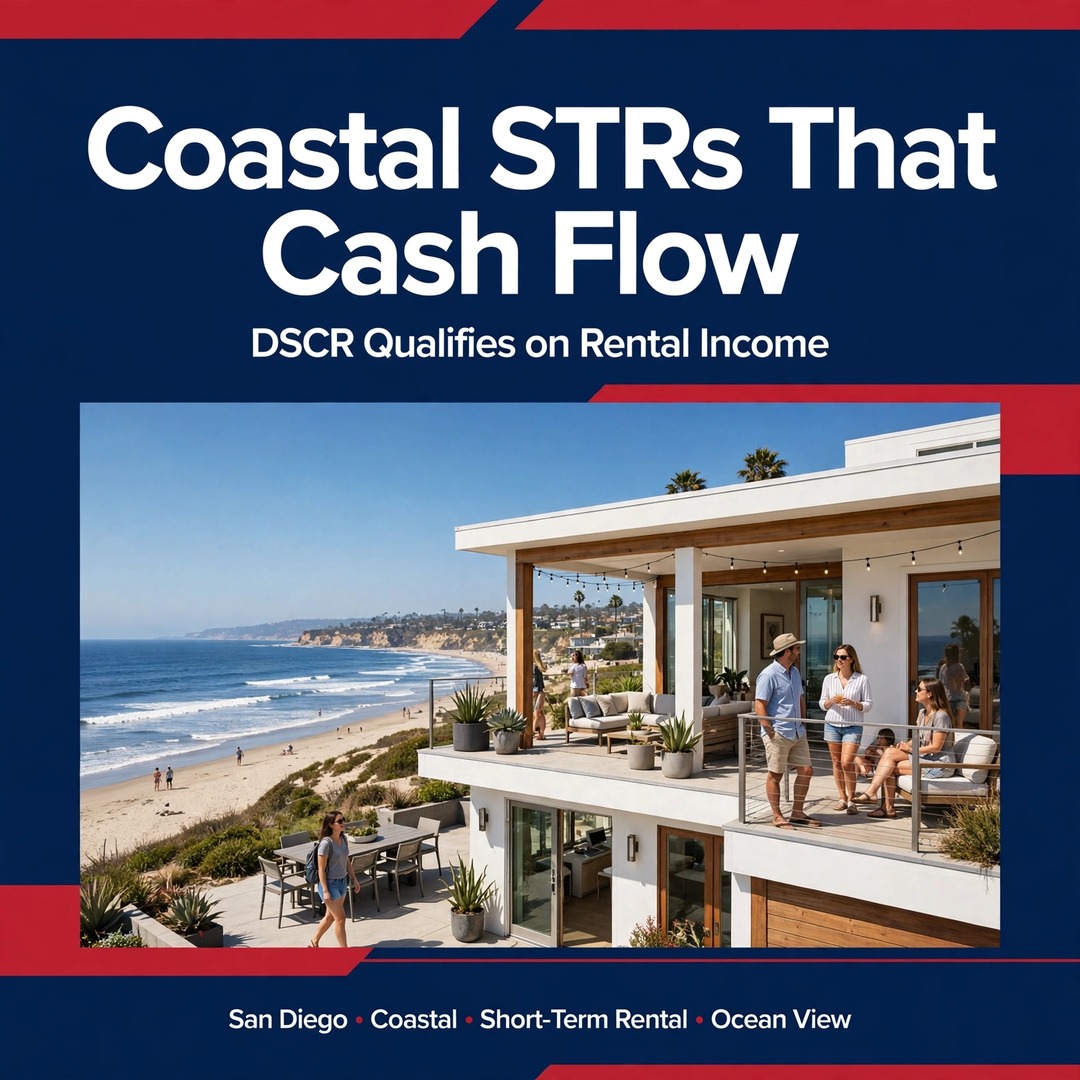
On the other side of the strategy spectrum are short‑term rentals (STRs) in coastal and lifestyle neighborhoods — Pacific Beach, Ocean Beach, La Jolla, parts of downtown and Little Italy. Here, your guests are weekend visitors, conference travelers, and families flying in for that perfect San Diego beach week.
San Diego now regulates STRs through a Short‑Term Residential Occupancy (STRO) licensing system. Whole‑home rentals (Tier 3) require a license, minimum annual usage, and compliance with tax and reporting rules. Mission Beach has its own capped license pool. The red tape is real — but so is the revenue potential when you secure the right property and license, backed by flexible DSCR loans that recognize short‑term rental income.

The same San Diego duplex can serve tourists or military families with the right strategy and financing.
A well‑located two‑bedroom near the beach might gross $6,000–$9,000 per month in peak season, then taper off in slower months. Your cash flow is more variable than a BAH rental, but your upside can be higher — especially if you blend tourism demand with mid‑term stays for traveling nurses or PCS‑ing families in between permanent homes.
💡 Pro Tip: When you model a San Diego STR, underwrite conservatively and make sure your DSCR still works at off‑season rates, not just peak‑season projections.
One Market, Two Paychecks: Comparing the Profiles
Think of San Diego as one market with two paychecks:
Military‑focused LTR: Lower gross potential than a high‑octane STR, but steadier occupancy, simpler operations, and tenants backed by BAH. Ideal for investors prioritizing stability and fewer moving parts.
Coastal STR: Higher gross income potential and tax advantages like bonus depreciation on furnishings, but with licensing risk, seasonality, and heavier management demands.
The key is matching the property to the strategy — and then using financing that underwrites the income stream you’re actually pursuing.
How Freedom Lending’s Hard Money and DSCR Loans Power San Diego Deals
In a high‑priced market like San Diego, the right capital stack matters as much as the right block. That’s where Freedom Lending comes in, with two tools tailored to investors: hard money for acquisition and rehab, and DSCR loans for long‑term holds.
Hard money loans: Move quickly on under‑market deals, value‑add duplexes near bases, or tired beach cottages you plan to convert into STRs. Close fast, renovate, stabilize rents — then refinance into longer‑term real estate investor loans.
DSCR loans: Freedom Lending’s DSCR loans qualify primarily on the property’s rental income — not your W‑2 or tax returns. That’s crucial in San Diego, where many investors are self‑employed, own multiple properties, or are still building their paper income.
Whether your strategy is a BAH‑backed long‑term rental near Naval Base San Diego or a licensed whole‑home STR in Pacific Beach, Freedom Lending can underwrite the deal based on what the property earns. Their DSCR programs recognize both traditional leases and STR income, so you can pick the strategy that fits the property — not the paperwork.
“In markets like San Diego, speed and flexible underwriting make the difference between watching a deal and owning it.”
— Freedom Lending, on pairing hard money with DSCR loans
California Equity, Texas Doors: Taking the Playbook on the Road
A growing pattern among San Diego owners is “California equity, Texas doors.” Here’s how it works: you tap the equity in a high‑appreciation California property, then redeploy that capital into cash‑flowing rentals in Texas, where purchase prices are lower, rents more easily cover the payment, and landlord‑tenant laws are more favorable. Freedom Lending’s DSCR loans qualify on the rental income of those Texas properties — not your W‑2 — so the doors you buy stand on their own numbers. Your California equity becomes the down payment, and the Texas rents do the talking.
Next Steps: Put San Diego’s Two Paychecks to Work
San Diego’s mix of military stability and tourism demand won’t solve the city’s affordability crunch, but it can absolutely power a thoughtful investment portfolio. Whether you’re leaning toward steady BAH‑backed rentals near the bases, higher‑octane STRs by the coast, or a hybrid California‑and‑Texas strategy, the common thread is smart, flexible financing — from hard money for acquisition to DSCR real estate investor loans for the long haul.
If you’re ready to explore hard money or DSCR options tailored to your San Diego or Texas plan, contact Rob at [email protected] or call 903‑806‑4400. Have your numbers ready — and let the income your properties can produce lead the conversation.

At Freedom Lending, we believe lending should be built on integrity, honesty, and transparency. Every client relationship is guided by trust, clear communication, and a commitment to helping you move forward with confidence.
Whether you're funding your next investment or growing your real estate portfolio, Freedom Lending is your pathway to financial freedom.



Call us
+1 346-594-6988
Email Us
Loan Programs
Resources
Company
Copyright © 2026 Freedom Lending. All rights reserved.